
The Lost Art of the Meeting Minute
and the hunt for ROI from AI productivity tools
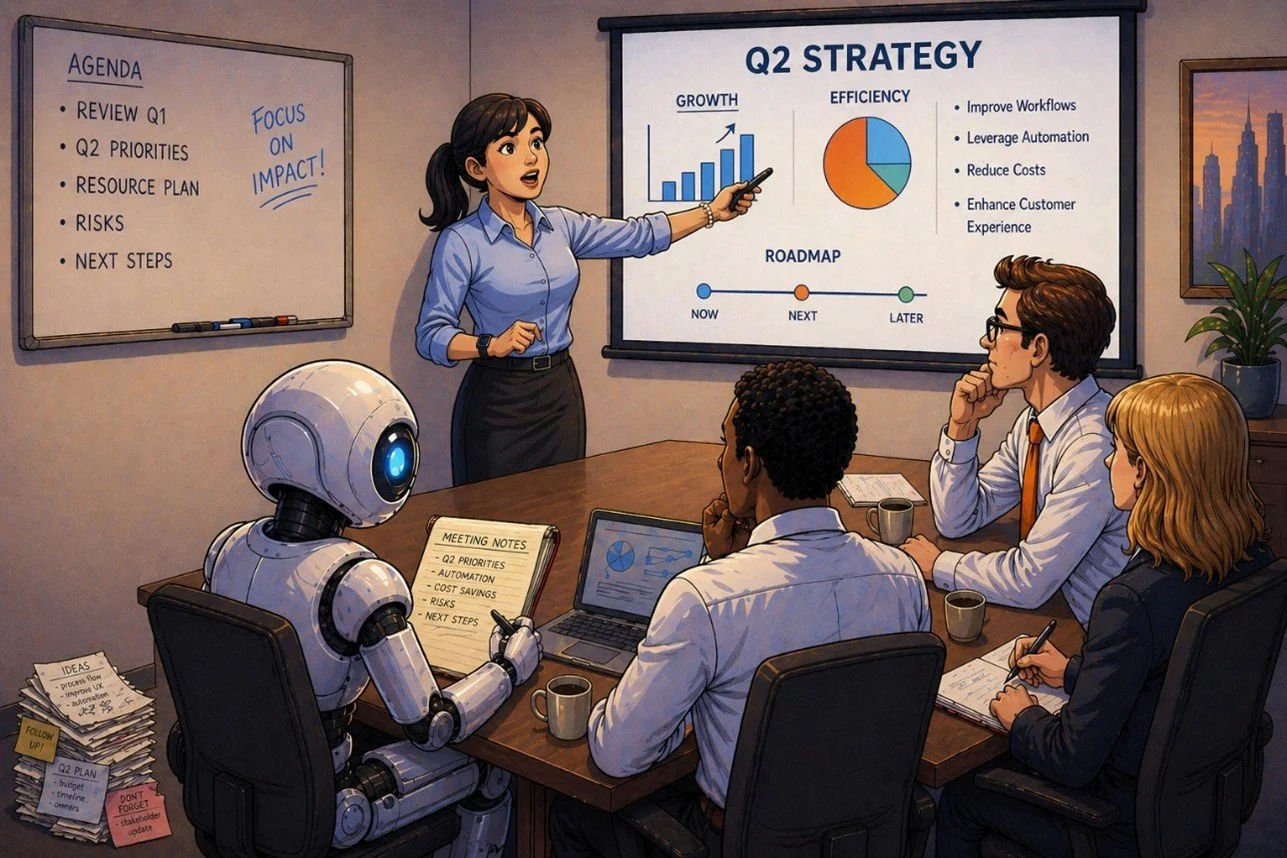
There is a particular kind of organisational amnesia setting in across the modern workplace, and it is being dressed up as progress. Across boardrooms, project teams, and executive committees, the humble meeting minute - one of the most underrated instruments of corporate governance - is being quietly retired in favour of AI-generated transcripts, automated summaries, and action-list algorithms. The pitch is compelling: less effort, more completeness, better accountability. In practice, the reality is often the reverse. In this piece I want to make an unfashionable argument: we are not yet in a better place than we were, and in many organisations, we are measurably worse off.
A discipline under threat
Let us start with what a properly drafted set of minutes actually represents. A skilled minute-taker is not simply transcribing what was said. They are performing an act of institutional curation. They are deciding, in real time and in post-meeting review, what matters. Which arguments shaped the final decision? Which concerns were noted and set aside? What was agreed, by whom, and on what basis? The result, when done well, is a concise and authoritative document that lands complex decisions with precision, creates an unambiguous shared record, and provides the organisation with a defensible history of its own governance.
This is not mere administrative housekeeping. The discipline of producing good minutes is itself a forcing function for clear decision-making. When someone knows a decision must be written down in plain terms, there is pressure - healthy pressure - to actually reach one. The ambiguity that flourishes in conversation must be resolved before the pen hits the paper, or the keyboard the screen.
That discipline is now under threat, and the agent of disruption is not incompetence. It is convenience.
The verbosity trap
AI transcription and summarisation tools - whether embedded in Microsoft Teams via Copilot, bolted on through Otter.ai, Fireflies, or their many equivalents - operate on a fundamentally different logic. They capture everything, and then attempt to distil it. The distillation, however, is where the problems begin.
AI-generated summaries are structurally prone to verbosity. Because the underlying model has no institutional knowledge, no understanding of organisational politics, and no appreciation of which argument actually shifted the room, it defaults to comprehensiveness. The result is often a document that is three or four times longer than a competent set of minutes would be, filled with paraphrased debate, restated concerns, and hedged conclusions. Action items may be correctly identified in isolation but stripped of the context that would make them actionable. Decisions are recorded, but the reasoning - the crucial "why" - is frequently flattened or lost entirely.
This verbosity is not merely an aesthetic problem. It creates a real and compounding accountability risk. Ambiguous minutes - minutes that record that a decision was made without clearly recording what was decided, or that capture multiple positions without clearly landing the conclusion - are an invitation to relitigate. Anyone who has sat in a follow-up meeting where participants dispute what was agreed will recognise this immediately. A well-drafted, concise minute forecloses that argument. A bloated AI summary opens it back up, offering multiple passages that can be selectively read to support competing positions.
Rotting notes
If verbose summaries are problematic, full transcriptions are something closer to organisational debt. Across enterprises adopting AI meeting tools at scale, cloud storage is quietly accumulating thousands of hours of verbatim recordings and their accompanying transcripts. These documents capture everything: the productive debate, the tangential distraction, the joke that landed badly, the half-formed idea someone floated and immediately retracted, the offhand remark made after someone believed the formal part of the meeting had ended.
None of this is being read. It cannot be. A ninety-minute strategy session produces a transcript of perhaps twenty-five thousand words. No busy executive is reading twenty-five thousand words of reconstructed conversation to find the three decisions that actually matter. The material sits in shared drives and cloud repositories, formally complete and practically useless - what one industry commentator has aptly described as "rotting notes." The promise of searchability is real in theory but requires users to know what they are looking for, to search consistently, and to trust that the AI has attributed statements correctly. On all three counts, the evidence is mixed at best.
There is also a more insidious consequence. The very completeness of a transcript changes how people speak in meetings. When participants know that every word is being recorded and attributed to them by name, the natural candour of professional debate is suppressed. The speculative idea, the challenging question, the honest admission of uncertainty - these are the lifeblood of good decision-making, and they require a degree of psychological safety that exhaustive verbatim recording actively undermines. Good minutes have always protected the deliberative process by recording its outputs, not its entrails. Full transcription exposes both, to unpredictable effect.
A nebulous benefit
Against this backdrop, the sustained claim that AI meeting tools are generating real, measurable return on investment deserves scrutiny that it is not currently receiving. Vendors and their advocates - including Microsoft's own positioning of Copilot across its enterprise client base - routinely cite figures suggesting significant productivity gains, time savings of 80-90% on note-taking, and substantial reductions in meeting hours. These numbers are almost universally drawn from vendor-commissioned surveys, self-reported user feedback, and market research with obvious commercial interests in the conclusions.
What is missing is rigorous, independent evidence that the quality of organisational decision-making has improved, that fewer decisions are being revisited, that governance is more robust, or that the time notionally saved on documentation is not being consumed by the effort required to check, correct, and contextualise AI-generated output. Because that checking burden is real. Any organisation that is treating unreviewed AI summaries as authoritative records is accumulating governance risk. Any organisation that is reviewing them carefully is not saving the time the tool was supposed to free up. The ROI arithmetic rarely survives contact with operational reality.
To claim, as some AI adoption advocates do, that these tools are transforming meeting productivity is, at best, a significant overstatement. At worst, it is a misrepresentation built on metrics that measure input activity - transcripts generated, summaries produced, tools deployed - rather than output quality or decision effectiveness. Organisations being encouraged to roll out personal AI tooling at scale on the basis of these claims deserve more honest analysis than they are typically getting.
Getting better vs good enough
None of this is to say the technology is without promise, or that it will not improve. AI summarisation is progressing rapidly, and the gap between what these tools produce today and what a skilled human minute-taker delivers is narrowing. The best current tools are meaningfully better than the worst, and the next generation - with deeper contextual understanding, organisational memory, and more sophisticated natural language reasoning - may yet reach genuine parity with human capability. In specific contexts, including multilingual meetings, accessibility for hearing-impaired participants, and asynchronous distributed teams, AI transcription already delivers real and legitimate value.
But "getting better" and "good enough" are not the same thing. And the widespread adoption of these tools, often driven by licence economics and top-down mandates rather than genuine fit-for-purpose evaluation, is outpacing their actual capability. In the meantime, the skill of drafting proper minutes - concise, authoritative, decision-focused, and genuinely useful - is being quietly devalued, its practitioners reassigned, and its discipline forgotten.
That is a loss worth naming. The meeting minute, properly conceived and competently executed, is not an administrative relic. It is a precision instrument for organisational clarity. Until AI can reliably replicate that precision - and it cannot yet - the case for protecting and practising the craft remains as strong as it has ever been.
In search of ROI
The meeting minute problem is, in microcosm, a story that is playing out across the entire landscape of broad personal AI tooling deployment. The pattern is by now familiar: a platform vendor - Microsoft being the most prominent, but far from the only one -bundles AI capability into the productivity suite that an organisation is already paying for. The commercial logic is compelling: the licence uplift feels modest relative to the headline promise, and the pressure to demonstrate digital leadership does the rest. Thousands of knowledge workers are enabled with AI assistants almost simultaneously, frequently with limited governance, minimal change management, and an expectation that measurable efficiency gains will follow as a matter of course.
The problem is not that these tools are without utility. Used selectively, by individuals who understand both their strengths and their limitations, many of them deliver genuine personal productivity benefit. The problem is the gap between that selective, skilled use and the indiscriminate, enterprise-wide deployment that the vendor model incentivises. When an organisation rolls out Copilot to ten thousand knowledge workers and reports that adoption is running at 70%, what it is actually measuring is licence activation, not value creation. The metrics that tend to follow - time saved per user (self-reported), documents summarised, emails drafted - are measures of output, not of effectiveness.
This distinction matters enormously. In knowledge work, the value is not in the volume of activity produced, it is in the quality of the judgment that activity represents. A senior manager who now drafts twice as many emails because Copilot autocompletes them has not become twice as productive - they may simply be generating twice as much noise. An executive who receives an AI summary of every document in their inbox has not become better informed if those summaries systematically flatten nuance and bury caveats. A leadership team that receives AI-generated minutes of every meeting it holds has not improved its governance if no one is rigorously checking those minutes for the precision and accountability that governance actually requires.
The honest assessment is that the measurable, organisation-wide ROI from broad personal AI tooling is, at present, largely unproven. The productivity gains that can be measured tend to be the ones that were easiest to automate and least consequential to get wrong. The costs - the time spent reviewing, correcting, and contextualising AI output; the decisions relitigated because the record was ambiguous; the institutional judgment quietly atrophying through disuse - are real, but they are diffuse, indirect, and do not show up in an adoption dashboard.